


Hi! Welcome back! I made my publishing deadline today, even with the MASSIVE edits and additions made in the final hour. Proud of that. Hope you dig it! This is (essentially) a continuation of my piece from last week — “The Mall”. It’s not required reading, but it’s, like, you know, part one. I’ll explain more in the paid subscriber videos (which are going up this week! All 5!). If you like what I’m doing, please consider subscribing.
Ok let’s get into it.
“Simply put, I respect art on the basis of it being a manifestation of an idea from a human being’s brain,” I say this with coffee jitters to my best friend walking around downtown San Diego. Once again, I’m defending James Cameron’s Avatar franchise like it’s an endangered species — and maybe it is.
Did a human being think of something and make it exist? It should be a low bar to clear, right? And, up until recently, that answer was clear, if not only occasionally obfuscated. Now the determination itself — the foothold on reality — is losing grip.
You don’t see Avatar fans in the wild like you do Star Wars fans, but one Avatar outgrosses most Star Wars films — and depending on how The Mandalorian and Grogu does this May, possibly all of the recent ones combined.
Defending Avatar in person, walking around, is healthier than shouting about it online. This is me thinking out loud. Seeing if I can add something to the conversation rather than reacting to someone else’s. The financial motive of art creation — content creation — has changed the engine of art and the discourse around it. Let me try something The Grid can’t do.
I went to Tron Night on October 28th, 2010 — an IMAX 3D preview for Tron: Legacy at the then brand-new IMAX screen at the AMC Foothills in Tucson. I went with my sister, they gave us posters and wristbands, and showed us 20 minutes of select scenes from the film. A few months later, I saw Tron: Legacy. And then I saw it again. Maybe four times total. This was 2010, and I was a teenager movie-hopping at the theater — watching every Academy Award-nominated film while sneaking into 3D showings of Tangled and Tron: Legacy. The world of Tron captivated my imagination more than most franchises, partly because it’s the ugly stepchild of modern sci-fi, while also being its architect — the Tron arcade game by Bally/Midway grossed nearly twice as much as the movie it was based on.
I loved it enough to write fan fiction — a pitch for a Tron series — and I loved it enough to get banned from Ain’t It Cool News for sharing it too aggressively.
A year later, my family moved to Rancho Palos Verdes, California, for seminary school, and I became an annual passholder at Disneyland — the top tier, no blackout dates, parking pass included. My sisters had the lower tiers, with the justification that I’d be the one actually going and taking them.
And I was. On more than one occasion, I’d get in an argument with my parents, get in the car, and drive myself to Disney California Adventure to haunt ElecTRONica — a Tron-themed dance party sponsored by Coke Zero. Flynn’s Arcade. Costumed dancers. DJs remixing the ‘80s over the synthpop of the moment — LMFAO, Gaga, Kesha. I don’t remember making friends there. Everyone apart from the California residents was visiting from all over the world, so it seemed pointless. I just showed up alone, sixteen years old, full of Coke Zero, and disappeared into the grid.
By 2019, I was still at it, tweeting a full pitch for a Tron prequel show from East Point, Georgia. My story (briefly) went like this: Kevin Flynn’s Grid has become the internet. ISOs — algorithmically-birthed intelligences like Olivia Wilde’s character in Legacy — have immigrated into the real world, and they’re legally required to stay on the Grid. Then, an evil force takes the Grid offline, trapping programs and human Users on the servers, essentially crashing the global economy and holding its population hostage. A team of hackers logs into a backup of the original 1982 Grid to find Tron — the only program who fights for the User — and override the shutdown. Digital immigration. Algorithmic consciousness. Border politics. I pitched all of that for fun, six years before it became the actual conversation.
Fifteen years after Tron Night, Tron: Ares finally arrived in theaters, and it was not exactly something I would have come up with. The basic premise — a program crossing into the real world — is what everyone wanted out of a Legacy sequel. But it took so long to make. And it flopped.
I found it pointless to see Tron: Ares in anything other than IMAX 3D, which, for my friends in Atlanta, meant tagging along down to Morrow, Georgia — not a short drive. I’d brought five friends to opening night. They cancelled our showing because of technical difficulties. The next day, I got two others — Tristan and Travis — to come with me, and I sat smack in the middle of the theater in the most ideal seat imaginable.
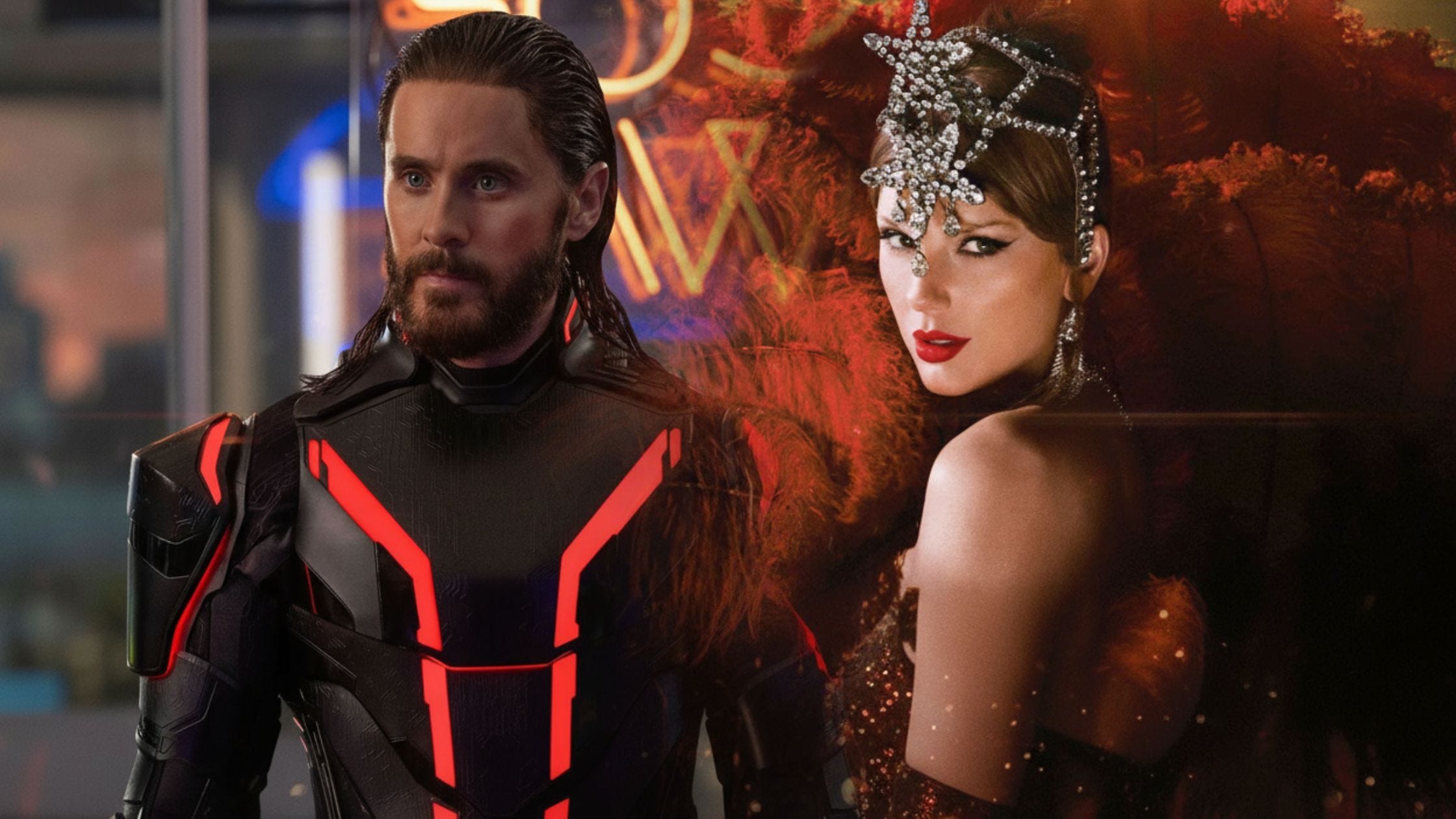
I had the best time. The film challenged me, because I had such a deep connection to the universe and my own ideas of what it should be. But the camera work is incredible. The 3D is perhaps more effective than Legacy, though Ares has fewer scenes inside the Grid. And the thing I have to respect — the thing that complicates any easy dismissal — is that Jared Leto is a genuine fan. He reached out to Disney about Tron in 2010, the same year I went to Tron Night. He saw the original in theaters in 1982 at ten years old. He spent a decade pushing to get Ares made, turning down an earlier version that didn’t feel right, executive producing the final film, and staying in character for the entire shoot. He called it a childhood dream.
Here are two Tron fans whose interests both peaked in 2010, both imagined their own versions of the next story, and both carried the obsession for fifteen years. One had the clout to will a hundred-and-seventy-million-dollar movie into existence. The other got banned from Ain’t It Cool News. Nobody showed up either way.
People call the Tron films cold — the visual style, the sterile geometry, the glacial pacing of the original. But all three are enormous labors of love that were never entitled to exist. The first was a commercial disappointment that became a cult landmark. Banned from Academy Awards eligibility for its use of computers. Legacy took twenty-eight years to get made. Ares took fifteen years and a decade of one actor’s obsession. None of these films were inevitable. They were willed into being by people who cared more than the market rewarded them for caring.
Did a human being think of something and make it exist?
Yes. Every time.
It still wasn’t enough.
It’s easy to forget that Taylor Swift is similarly not entitled to exist, not the person, but the phenomenon. The career she’s built is unprecedented, and the work that got her there is real. But with The Life of a Showgirl, I think she overplayed her hand.
I’ve been a hardcore Swiftie since 2007, and the thing I love most about her writing is the folk/country three-act storytelling she contorts into self-narrativizing massive universal pop. “You Belong With Me,” “Anti-Hero,” “Cruel Summer” — they all have that feeling of: set-up, escalation, and then that one all-caps moment where the floor drops out, or the roof blows off.
“Opalite,” in that spirit, is a fantastic song. It’s the best thing on the album that’s not named “Father Figure,” and it debuted with a metric ton of baggage and masses-assigned meaning.
The onyx-versus-opalite imagery — black stone, white stone — got read as a coded dig at Travis Kelce’s Black ex-girlfriend Kayla Nicole, especially alongside the second verse: “You were in it for real / She was in her phone / And you were just a pose.”
Swift's official merch store listed a silver chain for the song "Opalite" — eight lightning bolt-shaped links with an eight-pointed star pendant. A TikTok user pointed out that the bolts bore a resemblance to the Schutzstaffel insignia, the SS, and that eight of them could be interpreted as "88" — shorthand for "Heil Hitler," with H being the eighth letter of the alphabet. The video went viral. Within forty-eight hours, the necklace vanished from Swift's store. No statement. No redesign. Just gone.
Its music video features Greta Lee and Jodie Turner-Smith — both of whom star in Tron: Ares — alongside Cillian Murphy, who played Edward Dillinger Jr. in Tron: Legacy. They were all on The Graham Norton Show together, promoting their respective projects the same week Ares and Showgirl dropped. The Tron universe and the Swift universe sat on the same couch, and nobody blinked (‘cept me.) The song soundtracked the NBC promo for Team USA figure skating at the Winter Olympics. It’s a hit. The song that debuted with racism allegations and Swift-strung-strings is now just a pop single playing at the ice rink.
By December 2025, reports surfaced that the backlash had been partly coordinated — a network of inauthentic accounts seeding the accusations of far-right sympathies. The allegations started on 4chan and migrated to mainstream platforms, where even disagreeing with them fed the algorithm. But by then, the discourse had already run its cycle on The Grid.
So do the allegations matter? Does bad faith mean-making only work for short-term analytics and profit, and not in the head and heart? Will anyone remember that evaporated? Should we? What cements in our hearts, the grid has already processed and forgotten. But the human beings involved — Kayla Nicole, the TikToker who made the original video, and Swift herself — are still living with whatever it meant.
The algorithm already forgot. People don’t get to.
We treat creative works as singular visions — one name on the poster, one genius in the room. When that person is Taylor Swift, total control means the flaws are hers alone. The Life of a Showgirl doesn’t read as a committee product; it reads as a psychological reveal, which makes it deeply interesting but not pure fun. When that person is Jared Leto, the opposite happens. His name and his baggage swallow a film that hundreds of people built. Either way, the fingerprints vanish.
Even total artistic control can’t prevent meaning from escaping into the algorithm. And once it escapes, it moves fast.
I work in clothing and symbols daily. The things that become collectible, vintage, or honored earn that status because of the context in which they exist. At the drop of a hat, those things can lose their honor legitimately or otherwise. I don’t know what movement will be co-opted next, or which logo will curdle overnight. I don’t know what to do with Bill Cosby albums.
That same month, Maine Senate candidate Graham Platner — a Marine, an oyster farmer, a progressive backed by Bernie Sanders — was fighting to explain a tattoo he got drunk in Croatia in 2007 that turned out to resemble an SS symbol. Swift’s team could delete a product page. Platner had to cover his chest.
I’m not here to litigate whether Taylor Swift is a Nazi. That’s absurd. But the fact that a lightning bolt can detonate a cataclysmic discourse cycle overnight says something about how meaning works now. When art loses its individuality — often from the artist’s sole vision — it becomes cultural public domain. The symbol doesn’t belong to Swift, or Bowie, or even the designer who made the necklace. It belongs to whoever grabs it first, and the internet is always grabbing. The work is keeping the cultural public domain from becoming contextual collapse.
…
Hank Green has this argument I can’t stop thinking about: the social internet isn’t cigarettes. It’s food. For thousands of years, humans lived in information scarcity. The last generation that had to worry about too little information is still alive. Now we live in information abundance — and the people packaging that information are competing to make it as hyper-palatable as possible, the same way food companies engineer a Dorito to hack your brain into not realizing you’ve eaten the whole bag. Except with the internet, they can design a personalized Dorito for every single person, one that morphs and changes along with your interests to make sure it’s always perfectly engineered for you specifically. And as you fall down the rabbit hole, the Dorito keeps changing shape — worse and worse for you, as long as it keeps you eating. I linger on a song for twelve seconds, and suddenly my feed is telling me what I am.
The feed doesn’t just sell you things. It tells you who you are. It completes you before you’ve finished forming. It’s the opposite of the clearance rack, the opposite of the mall. The mall lets you be anonymous. You walk in, you browse, nobody’s tracking which aisle you paused in or how long you held the jacket before putting it back. The grid insists on knowing you. It builds a model of you faster than you can build one of yourself, and then it feeds that model back to you as a recommendation, a playlist, an ad, a political identity. Like the Tron programs worshipping their Users, we worship the feed — its focus, its outrage, its belonging. Ritualized judgment. This is our new religion.
Green made a TikTok about the Swift necklace controversy. His argument was simple: this is performative outrage that fragments the Left’s ability to organize around anything that matters. The intense scrutiny of Swift reflects a political moment where people vent their powerlessness by targeting visible figures rather than larger systems. Outrage as the Left’s new sacrament. Accountability as entertainment economy.
And then people attacked Hank Green for defending Taylor Swift instead of focusing on Palestine, which is exactly the cycle he was describing, which is exactly the point.
This isn’t media criticism. This is grief. I think what breaks my heart the most is the massive amount of work done by myself and people on the left to seek to understand — or even defend — the religious right’s support of Trump. But they’ve never moved. Not once. And since October, the news has only accelerated this. The systems are eating themselves. The discourse eats the discourse about the discourse. Every week, a new symbol detonates, a new figure is weighed and found wanting, and the structural conditions that make all of it possible go completely untouched.
So where does that leave us? As people? It leaves me thinking that where you put your emotional investment has to be for the good of the grid, so to speak. I fight for the User, like Tron. Not the algorithm, not the feed, not the shareholder value, not the cycle. The User. The person on the other end of the screen who is, presumably, still a human being who made a choice to be here.
I’m now in a non-Tron-themed dance club on a Saturday night. They only have Diet Coke from the soda gun, not Coke Zero. The music isn’t very eighties at all — eighties night is getting older every night. Like a wallflower that works out, I observe coordinated commotion. What am I signalling?
Tyler Scruggs is a writer, musician, and thrift store manager based in Tucson, Arizona. His new album, In Town For Work, is coming in 2026.