


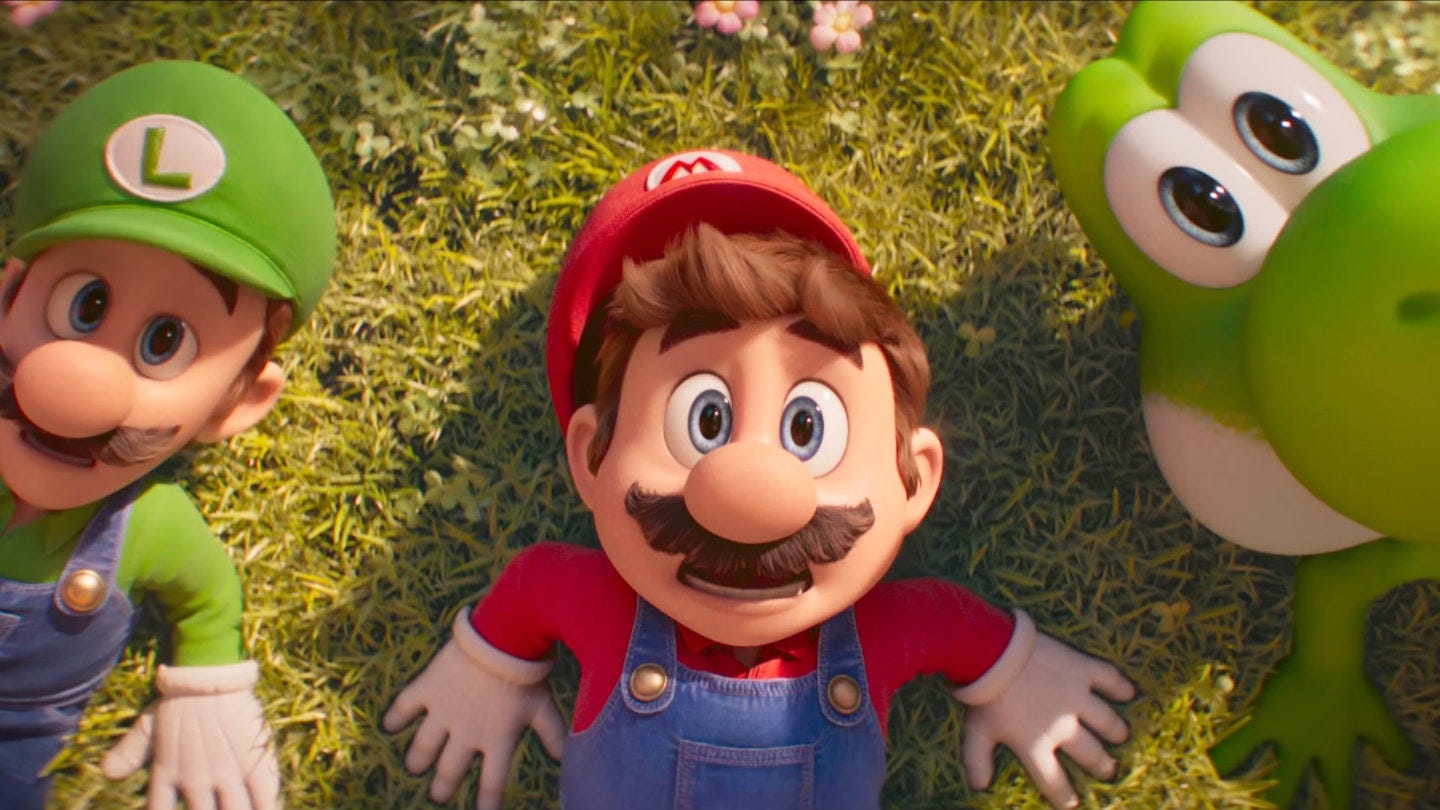
When I was a kid, I used to take apart radios and walkmans and CD players just to see what was inside. Only once I had all the pieces, I realized I didn’t know what I was doing — that there was probably someone smarter and more qualified to do what I was trying to do. That once I had deconstructed the electronics, it might as well have been magic to me, and I’m no closer to understanding electronics and even further from a working Walkman.
Which is why Nintendo called Universal Studios up, right? Why the movie isn’t just rendered cutscenes compiled into a direct-to-streaming story? When I was a kid, we had The Super Mario Bros. Super Show. Now we have a $110 million animated film that is gorgeous, relentless, and has no plot with no interest in getting one, either. And I mean that in the most neutral way I can manage.
Conflicts are resolved as quickly as they arise. Everyone is friends. There is no underlying dynamic except whatever the character needs to be doing in a given moment. It gave me sequel-era Star Wars. Some Attack of the Clones energy, specifically, not because it’s bad in the same way, but because it exists primarily to move pieces around a board for future movies while wearing the costume of a story.
The movie knows this. Every scene presents a problem and then immediately presents the only obvious in-universe conclusion that could be drawn from it. Luigi gets handed a paintbrush and creates Mr. Game & Watch. Pikmin show up. Fox McCloud arrives like a Han Solo who has other movies to get to. The film is building toward a Super Smash Bros.- Avengers moment and it is not subtle about it. It’s a 98-minute pitch deck where every Easter egg is a line item: this character exists, you will want a movie about them.
This isn’t fan service exactly. Fan service rewards you for knowing the lore. This is franchise architecture. Infrastructure made Industrial-Chipotle-Core. The difference between a movie that loves its source material and a movie that is quietly constructing a real estate portfolio out of it.
It’s kind of interesting to have a universe so rich and an audience so wide that four-quadrant filmmaking is what’s really being tested to its limits here. It’s never overwhelming, but it never stops.
The Super Mario Galaxy Movie is literally not required to make sense or have a plot or be emotionally resonant, so it isn’t. It does have a mandate to be pretty, have jokes — and honestly, some of this was visually stunning enough that I did not care too much that there was essentially no characterization for any single character, even established ones. But you are also talking to someone who is actively collecting every 3D movie commercially released.
Spielberg once said he doesn’t take a job just for the sake of working — he sits it out until he finds something he’s passionate about.
The Super Mario Galaxy Movie wants that same emotional contract — it wants you to feel the Nick Fury post-credits excitement, the aren’t you ready for the next one — but the next one is inevitable. It’s already announced. So you take it for granted before the lights come up.
Phil Lord and Chris Miller have built an entire career out of taking things nobody asked for — Cloudy with a Chance of Meatballs, 21 Jump Street, The Lego Movie — and making them matter by actually caring about what’s underneath. The Lego Movie works not because it has Easter eggs but because the Easter eggs serve something real. You’re so engaged with the film itself that a random cameo isn’t a reference — it’s a moment. That’s the difference.
The Super Mario Galaxy Movie has one goal: to be a movie. Not to mean something. Not to subvert anything. Not to earn your surprise. Just to exist in movie form. The cameos aren’t in service of a theme. They are the theme.
I was not surrendering to an auteur’s vision in that theater. I had the controller. The movie handed it to me and I just... held it. Watching someone else play. And yet, I’m hunting eBay for the Germany-exclusive 3D blu-ray of The Super Mario Bros. Movie.
The R36S is a generic-Temu retro game console shaped like a Game Boy I bought that plays pretty much every game you can think of made before 2004. Anyway it nearly fried a few weeks ago when I plugged a wifi dongle into it. It doesn’t quite work out of the box. You have to replace the SD card, flash new open source software, and make sure you don’t brick it. I’ve been learning to flash the software , load ROMs, learn Raspberry Pi — not romantically, not as a bit, but because it matters to actually understand the systems you’re inside of. When the screen went white I sat there with all the pieces and didn’t know what to do. Then after a while, everything went back to normal. That’s the thing about systems — they have their own logic. You can’t just walk into them, call yourself fluent, and expect the pieces to behave.
I am not immune to any of this. But even for Super Mario, there’s a more intelligent and heartfelt through line to be had here. Right? Right?
Why is that star that talks like a young child reminding me of death and that nothing matters all the time? Right in front of my Super Mario movie?
Where’s my Game Boy?
Tyler Scruggs is a writer, musician, and thrift store manager based in Tucson, Arizona. His new album, In Town For Work, is coming in 2026.
Disappointing but I’ll still go. Waddayagonnado lol